Guide

Measuring AI ROI and PerformancePractical implementation playbook.

AI ROI is strongest when teams measure business outcomes and operating quality together, not just model output speed or volume.
ROIAnalyticsPerformance

Guide quick facts

Estimated read time

14 min read

Primary audience

Executives, operations leaders, and analytics owners who need defensible metrics for AI impact, adoption, and scale decisions.

Outcome focus

Measurable workflow performance with secure, scalable operating patterns.

What You Will Learn

How to move from concept to dependable execution

Build an ROI framework that ties AI activity to business outcomes and cost changes.

Track workflow health, quality, and adoption metrics in one operating view.

Use leading indicators to detect performance drift before business impact declines.

Create decision-ready reporting for scaling, tuning, or retiring workflows.

Measuring AI ROI and Performance

Guide focus

Track and measure the return on investment and performance of your AI implementations.

Preparation

Before you implement

These prerequisites and setup checks help teams reduce rollout delays and quality issues.

Prerequisites

  • Baseline metrics from the pre-AI process for speed, quality, and effort.

  • Clear financial and operational goals tied to AI workflow outcomes.

  • Data sources for cost, throughput, quality, and user adoption.

  • Stakeholder alignment on reporting cadence and success thresholds.

Launch checklist

  • Define an ROI scorecard that includes value, quality, adoption, and risk.

  • Capture pre-rollout baseline metrics for all targeted workflows.

  • Instrument workflow runs, approvals, and rework paths for full visibility.

  • Run recurring performance reviews and tune workflows using evidence.

  • Scale only workflows that meet defined value and governance thresholds.

Implementation Roadmap

Step-by-step path to production readiness

Follow these phases in sequence and adapt the controls to your team, risk profile, and rollout timeline.

Step 1

Phase 1: Define the value model

Agree on how AI creates measurable business impact.

Execution actions

  • Classify value drivers as revenue, cost, speed, risk, or quality gains.

  • Set metric owners and data sources for each value driver.

  • Define leading and lagging indicators to avoid delayed insight.

How Super Amplify helps

  • Use workflow analytics to connect run behavior with operational outcomes.

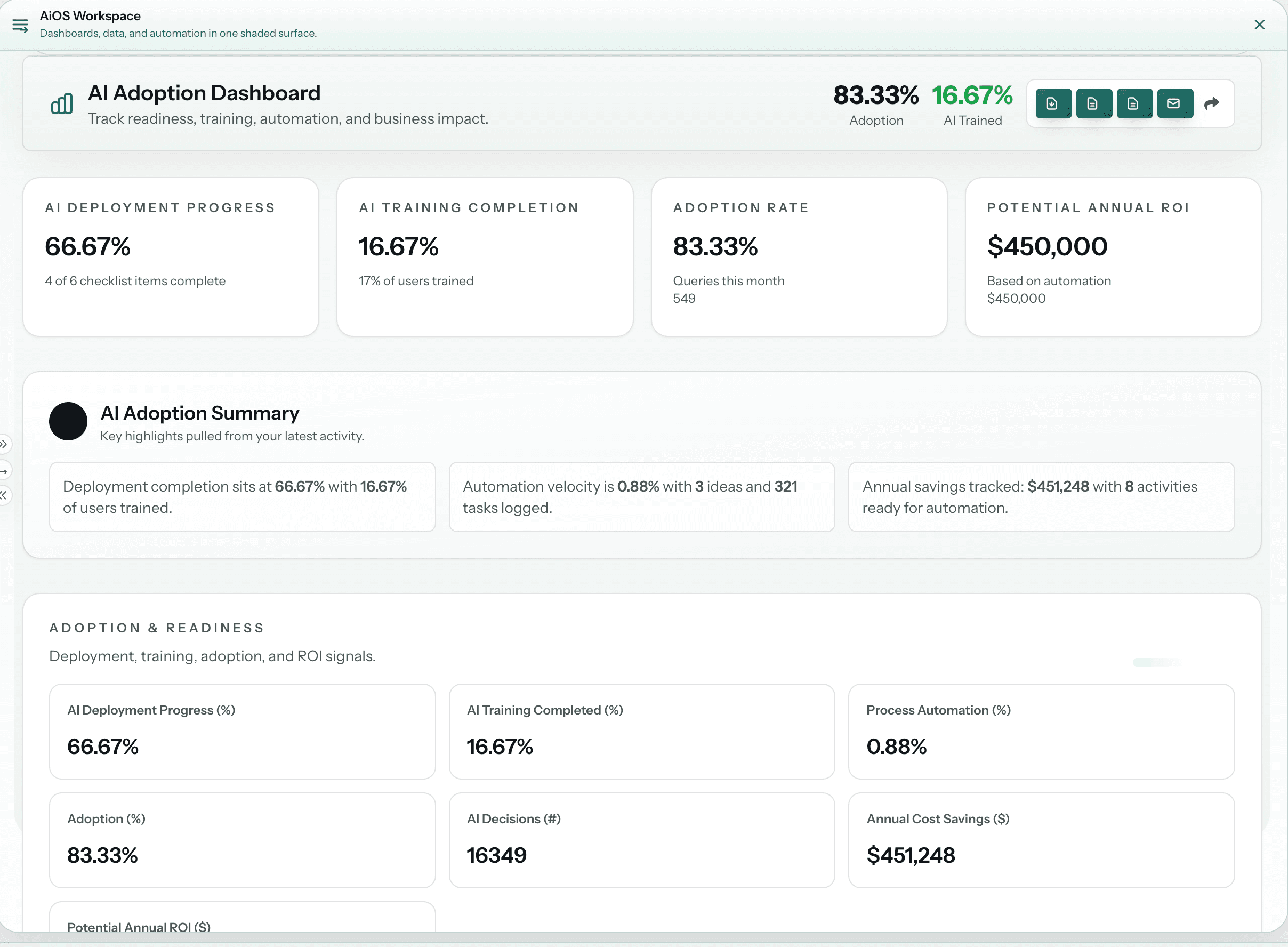
  • Use dashboarding to combine adoption, quality, and throughput in one view.

  • Use shared reporting workspaces for alignment across leadership and operators.

Step 2

Phase 2: Instrument and baseline

Collect dependable measurement data before and during rollout.

Execution actions

  • Capture baseline process metrics before scaling AI-assisted workflows.

  • Track workflow-level events including approvals, failures, and rework.

  • Segment results by team, process type, and risk tier.

How Super Amplify helps

  • Use run and audit logs as a consistent measurement foundation.

  • Use workflow labels and grouping to compare performance by segment.

  • Use exportable analytics views for finance and operations review.

Step 3

Phase 3: Optimize performance

Improve outcomes continuously based on evidence.

Execution actions

  • Run monthly optimization reviews for underperforming workflows.

  • Tune prompts, routing logic, and approval thresholds where needed.

  • Retire low-value automation and reallocate effort to high-impact flows.

How Super Amplify helps

  • Use comparative run analysis to identify high-leverage tuning opportunities.

  • Use version tracking to monitor which changes improve ROI and quality.

  • Use governance controls to keep optimization aligned with policy.

Step 4

Phase 4: Scale with confidence

Expand investment into workflows with proven, repeatable impact.

Execution actions

  • Publish scorecards for each workflow covering value, reliability, and risk.

  • Create scale criteria for funding and rollout prioritization.

  • Communicate impact and tradeoffs in executive-ready reporting.

How Super Amplify helps

  • Use portfolio dashboards to prioritize AI investments by measurable impact.

  • Use reusable workflow templates to accelerate expansion into new teams.

  • Use centralized reporting to support governance and budget decisions.
Super Amplify Advantage

How Super Amplify helps you accomplish this guide

These capabilities are the leverage points teams use most often to move faster without sacrificing quality or governance.

Provides one analytics surface for workflow output quality, adoption, and business impact.

Improves decision quality with run-level visibility and trend analysis over time.

Supports ROI governance through traceable metrics, versions, and policy context.

Accelerates scale decisions by making high-performing workflows easy to identify and replicate.

Risk and Measurement

Common pitfalls and scorecard metrics

Use this risk checklist and KPI set to keep implementation quality high as adoption expands.

Common pitfalls

Tracking activity instead of outcomes

Impact: Teams report usage growth without proving business value.

Prevention: Tie each metric to a financial or operational objective before launch.

No baseline for comparison

Impact: Performance claims are hard to validate and defend.

Prevention: Capture pre-AI process metrics and keep them in the same reporting model.

Ignoring quality and risk in ROI models

Impact: Short-term efficiency gains hide long-term governance and rework costs.

Prevention: Measure quality, policy exceptions, and rework alongside speed and cost.

KPI scorecard

Net value per workflow

Quantifies total benefit after costs and operational overhead.

Healthy range: Positive and expanding in targeted workflow categories.

Adoption depth

Shows whether teams are using workflows consistently in real operations.

Healthy range: Sustained active use across priority user groups.

Quality-adjusted throughput

Balances speed gains with output quality requirements.

Healthy range: Throughput growth without rising rejection or rework rates.

Risk-adjusted automation rate

Ensures scaling does not outpace governance controls.

Healthy range: Increase over time while policy violation rates remain low.